Few symbols in tattoo art carry as much weight as the snake. It shows up in ancient mythology, religious texts, medical imagery, and modern ink with equal force. The serpent tattoo meaning is layered and often contradictory, which is exactly what makes it one of the most requested designs across every style and era.
This guide breaks down snake tattoo symbolism from every angle, including the cultural roots, the design variations, and the deeper meaning behind each one.
Why the Snake Tattoo Carries Two Opposite Meanings
A snake tattoo symbolizes a powerful duality. It represents transformation, healing, and rebirth on one side, and danger, poison, and temptation on the other. That tension between creation and destruction is what gives the serpent its staying power as a tattoo motif.
No other animal carries so many conflicting associations. A snake can be a protector or a predator, a healer or a threat. It can mean wisdom in one culture and evil in another. People who are drawn to snake tattoo designs tend to connect with that complexity. Life is not one thing. The serpent reflects that honestly.
Rebirth, Healing, and the Positive Side of Snake Tattoo Symbolism
The most recognized positive meaning of a snake tattoo is rebirth and transformation. Because snakes shed their skin as they grow, they have long been connected to the idea of releasing what no longer serves you and moving forward renewed.
This is part of why the serpent appears in one of the most recognizable medical symbols in the world. The Rod of Asclepius, a single snake wrapped around a staff, has represented healing since ancient Greece. You can still find it carved into the facades of older hospital buildings and medical institutions in New York City. For people in healthcare, or anyone who has been through a period of recovery, a snake tattoo can hold deep personal significance.
Temptation, Danger, and the Serpent’s Edge
A snake tattoo can also represent temptation, danger, and mortality. This darker side of serpent tattoo meaning traces back to the story of the Garden of Eden, where the serpent offered forbidden knowledge, and to the very real danger posed by venomous species.
But “negative” does not always mean unwanted. Many people choose a snake tattoo design because they identify with that edge. It can signal resilience, a willingness to face hard truths, or a refusal to be underestimated. In a city built on reinvention, where people constantly shed old versions of themselves to become something new, that symbolism hits differently.
What Snakes Mean in Different Cultures
Serpent symbolism varies dramatically across cultures, but one thing stays consistent. Every major civilization has given the snake a prominent role in its mythology.
Culture | Associated Meaning |
Ancient Egyptian | Royalty, protection, divinity |
Ancient Greek | Healing, medicine, the Rod of Asclepius |
Japanese / Irezumi | Good luck, protection, strength, wisdom |
Hindu | Creative life force, cosmic energy, Kundalini |
Celtic | Eternity, interconnectedness, the cycle of nature |
Mesoamerican | Divine knowledge, the feathered serpent Quetzalcoatl |
In Japanese tattoo traditions, the snake is a guardian figure. It wards off illness, protects against bad luck, and symbolizes strength gained through adversity. Japanese snake tattoo meaning carries a reverence that feels very different from Western interpretations, and it opens up a rich set of design possibilities within the Irezumi style.
In ancient Egypt, the cobra represented Wadjet, a goddess of protection. Pharaohs wore the uraeus, a rearing cobra, on their crowns as a sign of divine authority. That connection between the serpent and power has echoed through centuries of art and body marking.
Popular Snake Tattoo Designs and What They Mean
The specific design you choose changes the meaning of your snake tattoo significantly. A coiled serpent tells a different story than one swallowing its own tail, and the details matter.
The Ouroboros Tattoo and What It Means
The ouroboros, a snake eating its own tail, is one of the oldest symbols in recorded history. It represents the cycle of life and death, infinity, and the idea that endings are also beginnings. Ouroboros tattoo meaning resonates with people who see life as a continuous loop rather than a straight line. This design works beautifully as a fine line tattoo because the circular form lends itself to clean, delicate linework.
Two Snakes Tattoo Meaning
Two snakes tattoo meaning often points to balance. The image echoes the caduceus and carries themes of duality, partnership, and opposing forces working in harmony. Some people choose this design to represent a relationship or an internal balance they have worked to achieve.
Snake Wrapped Around a Dagger
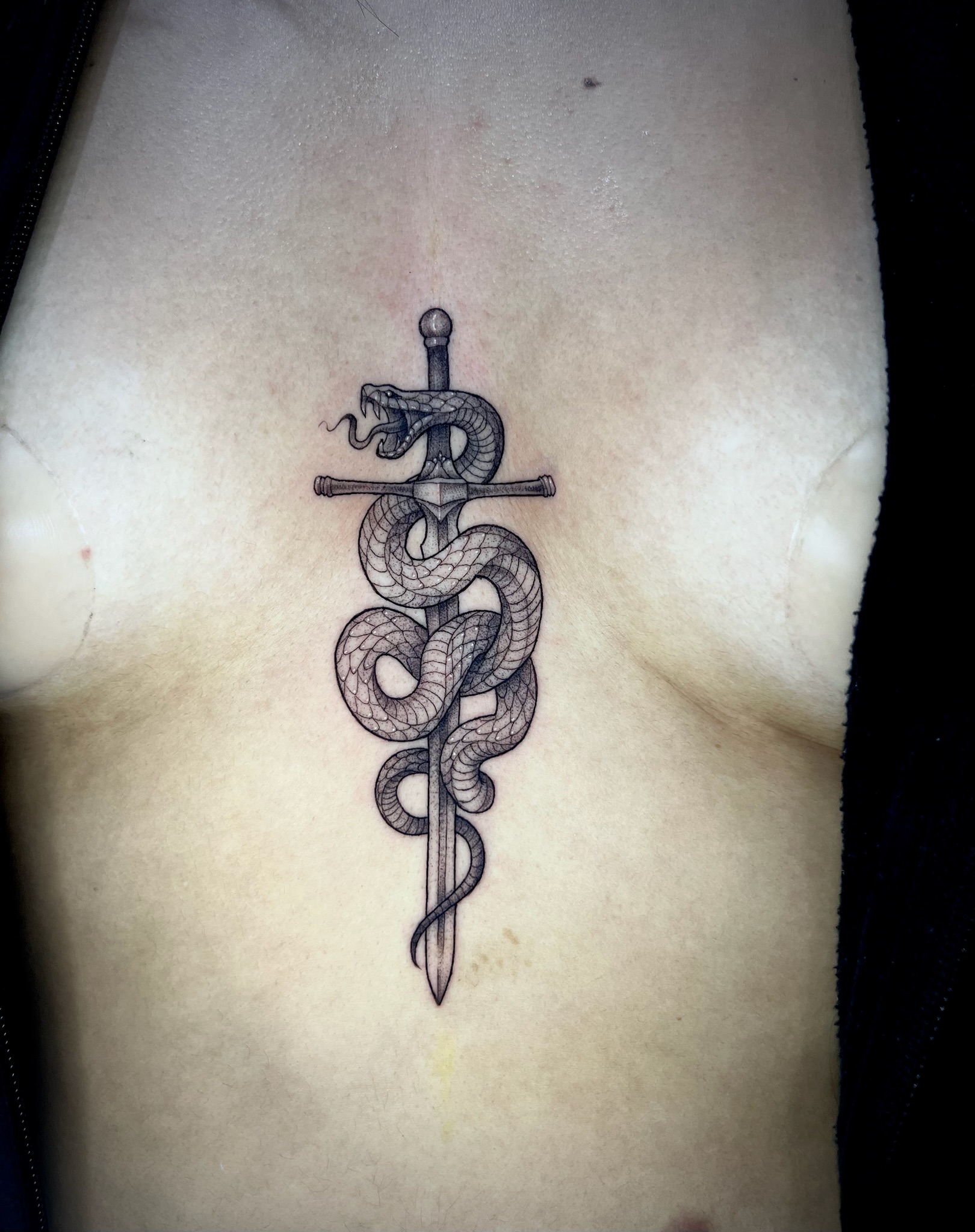
A snake wrapped around a dagger is a classic tattoo motif. It can symbolize overcoming hardship, the courage to face danger head-on, or the relationship between risk and reward. This design has roots in traditional American tattooing but translates well into modern graphic styles and illustrative approaches.
Snake and Flower Tattoo Meaning
Pairing a snake with florals creates a contrast between softness and strength. Snake and flower tattoo meaning often centers on the tension between beauty and danger, growth and decay, or love and loss. Roses are the most common pairing, but peonies, lotuses, and wildflowers each add their own layer.
From Fine Line to Bold Graphic, the Best Styles for a Snake Tattoo
Snake tattoo designs are incredibly versatile, and the style you choose can shift the entire mood of the piece.
A fine line snake tattoo emphasizes elegance and subtlety. The serpent’s natural curves translate perfectly into thin, flowing linework, making it a popular choice for placements like the forearm, ribcage, or wrapping around the wrist. Small snake tattoo designs in fine line are especially popular for a first or second piece.
On the other end of the spectrum, bold graphic and illustrative interpretations lean into the snake’s more dramatic qualities. Heavy black ink, sharp angles, and abstract compositions give the design a contemporary, almost architectural feel.
For anyone drawn to traditional aesthetics, Japanese-style snakes tend to be larger, more colorful, and rich with symbolic detail. And realistic or micro-realism snake tattoos capture the texture of scales and the intensity of the serpent’s gaze in stunning detail.
Where to Place a Snake Tattoo for the Best Look
The snake’s elongated shape makes it one of the most adaptable designs when it comes to placement. A snake tattoo on the arm, wrapping from the wrist up toward the elbow, follows the body’s natural contours and creates a sense of movement. The spine, ribs, and thigh are also popular spots, especially for longer compositions that take advantage of the serpent’s flowing form.
Smaller placements work too. A tiny coiled serpent behind the ear, a single-line ouroboros on the ankle, or a small snake tattoo along the collarbone can be meaningful without being large. The key is working with an artist who understands how the design will sit on your specific body and how it will age over time.
Choosing the Right Snake Tattoo Design for You
A snake tattoo is a commitment to a symbol that has meant different things to different people for thousands of years. Before you book, spend some time thinking about which layer of serpent tattoo meaning resonates most with you. Is it the transformation? The protection? The rebellion? The design should reflect that intention.
Talk to your artist about the style, size, and placement that will bring your vision to life. A good consultation is where the concept becomes real, and where the snake starts to feel like yours.