There’s something quietly powerful about a bird that weighs less than a nickel yet flies thousands of miles every year. Hummingbirds carry a kind of contradiction in their wings, soft and relentless at once, and that contradiction is exactly why they end up on so much skin. People reach for this design when they want something pretty, sure, but also when they want something that means what they’ve lived through.
If you’ve been turning the idea over in your head, the hummingbird tattoo meaning runs deeper than most people realize. It pulls from centuries of folklore, personal storytelling, and a kind of visual shorthand for joy that doesn’t need explaining.
What Does a Hummingbird Tattoo Symbolize?
A hummingbird tattoo most often stands for joy, resilience, and the ability to keep moving forward through hard seasons. It’s a symbol of staying light on your feet, even when life asks more of you than feels fair.
Beyond that single line, the symbolism branches out in a few directions. Hummingbirds are tied to freedom because of how they fly, hovering, darting backward, pivoting mid-air without warning. They’re tied to presence because they live almost entirely in the moment, fueled by whatever bloom is in front of them. And they’re tied to renewal, since seeing one in many traditions is read as a sign that something good is on its way back to you.
Cultural Roots Behind the Hummingbird
The bird shows up in stories from cultures across the Americas, and each one adds another layer to what wearing one can mean.
Native American Symbolism
Across many Native American tribes, hummingbirds are seen as healers and bringers of light. They appear in legends as messengers between worlds, carrying prayers upward and good fortune back down. A tattoo drawn from this tradition often leans into themes of emotional healing, harmony, and quiet protection.
Aztec and Central American Symbolism
In Aztec belief, the hummingbird was tied to warriors. Fallen fighters were thought to return as hummingbirds, drinking nectar and warming themselves in the sun before being reborn. Huitzilopochtli, one of the central Aztec deities, was depicted with hummingbird features and represented strength, courage, and rebirth, according to the Smithsonian’s Encyclopedia of Latino History and Culture. Choosing a design with this lineage in mind often signals courage, transformation, or honoring someone who’s passed.
Popular Hummingbird Tattoo Ideas
The way you pair a hummingbird with other elements changes its story completely. Two people can get the same bird and walk away with two entirely different pieces of art.
Here’s a breakdown of common pairings and what they tend to signal:
Design Pairing | What It Often Represents |
Hummingbird with lotus | Spiritual awakening, rebirth |
Hummingbird with rose | Passion, devotion, romantic love |
Hummingbird with cherry blossom | The beauty of fleeting moments |
Hummingbird with daisy | New beginnings, gentle joy |
Hummingbird with sunflower | Loyalty, warmth, lasting energy |
Hummingbird with name or date | Memorial, honoring a loved one |
Hummingbird in flight, no extras | Freedom, independence, motion |
Pairing a hummingbird with floral elements woven into the composition is one of the most requested approaches, partly because it mirrors the bird’s real life and partly because flowers carry their own quiet symbolism that compounds the overall meaning.
Why Fine Line Suits Hummingbirds So Well
Fine line work captures the softness and motion of a hummingbird better than heavier styles, because the wings need to feel like they’re vibrating, not sitting still.
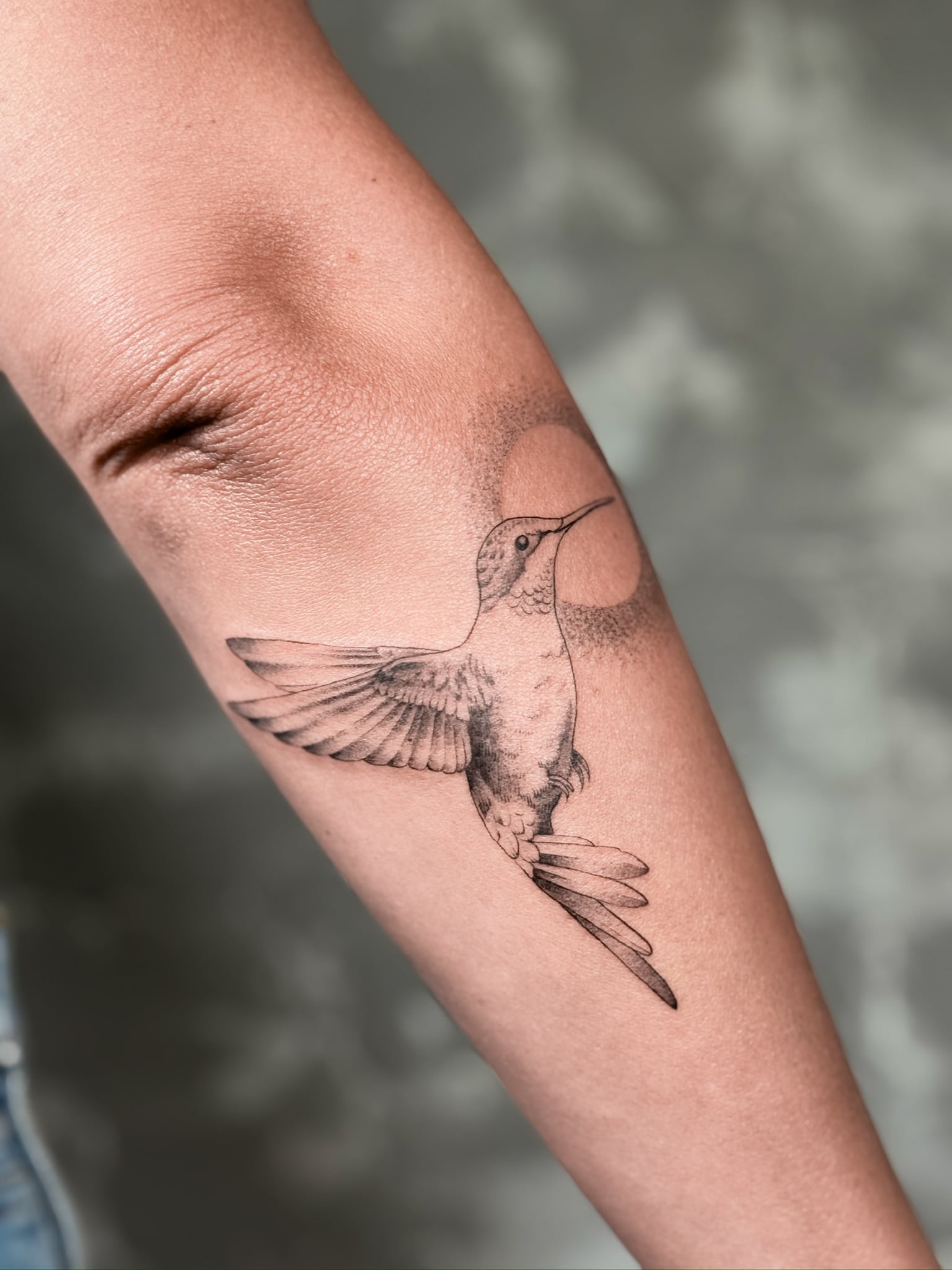
A hummingbird tattoo fine line approach uses single-needle technique to draw feathers, beak, and wing edges with thin, careful strokes. The result reads more like an illustration in a vintage natural history book than a bold graphic. There’s room for negative space, which mimics the blur a real hummingbird’s wings create at roughly 50 to 80 beats per second. Heavy black-line traditional styles tend to flatten that motion. Fine line keeps it alive on the skin.
This is why so many of our clients in NYC gravitate toward the delicate fine line style for nature-based pieces. It also ages in a softer way for people who prefer a tattoo that looks lived-in rather than freshly stamped.
Best Placements for a Small Hummingbird Tattoo
Placement matters more with hummingbird designs than with most other motifs, mainly because the bird is in motion. The body part you choose either reinforces that motion or fights against it.
A small hummingbird tattoo tends to land most beautifully on these areas:
- Behind the ear. Reads as private, almost a secret you carry with you. The curve of the skin gives the wings a natural lift.
- Lets the bird appear mid-flight, hovering near the throat. Pairs well with delicate floral sprigs.
- Inner forearm. Visible to you constantly, which is the point if the tattoo marks something you’re working through.
- Back of the neck. Subtle and easily covered, but striking when revealed.
- Ribcage or side. Allows for a slightly larger composition that follows the body’s curve.
- Ankle or back of the calf. Suits people who like their tattoos to feel like they belong to them alone.
For anyone leaning toward something tucked away and minimal, smaller micro pieces work especially well with this subject because the bird’s natural scale already lives in that delicate range.
How to Choose Between Color and Black and Grey
Both routes have a strong case. Color hummingbirds, particularly with iridescent green, blue, and pink notes, capture the bird’s actual appearance and feel celebratory. They suit people who want the tattoo to read joyful from across the room.
Black and grey or pure black fine line versions, on the other hand, lean into mood and shape rather than spectacle. They tend to age with more grace, and they pair more cleanly with future tattoos if you’re building a collection over time. Neither choice is more correct, it depends on what story you want the bird to tell.
What Makes a Hummingbird Tattoo Feel Like Yours
The hummingbird is one of the few designs where the public symbolism and the private one almost always overlap. People who lose someone often pick this tattoo because a real hummingbird visited their window after the loss. People recovering from illness pick it because the bird’s stamina mirrors their own. People who survived something hard pick it because the wings keep moving no matter what.
There’s no wrong reason to want one, and the design holds up under both heavy and light interpretations. What matters is that the version you walk out with feels like yours, drawn in a way that respects both the bird and the story you’re attaching to it.