Koi fish have carried weight in Japanese art for centuries, and that depth is exactly why people keep choosing them for tattoos. The design looks gorgeous on skin, but the story behind it is what makes the piece feel personal years after the session ends. If you’re drawn to this imagery, the colors, direction, and pairings all shift the meaning in ways worth understanding before your artist sketches anything.
What Is the Core Meaning of a Koi Fish Tattoo?
The koi fish tattoo meaning centers on perseverance, inner strength, and pushing through obstacles that feel bigger than you are. The story comes from an old Chinese legend later absorbed into Japanese folklore. A school of koi swam up the Yellow River, fighting the current toward a waterfall. Most turned back. One refused. After a hundred years of trying, that single fish reached the top and was transformed into a golden dragon by the gods.
That myth is why koi imagery shows up so often during turning points in people’s lives. Career shifts, recovery, new chapters after loss, or quiet personal wins that nobody else really sees. The fish becomes a marker for the climb itself, not the finish line. You can read more about the cultural roots of this legend in the Smithsonian’s coverage of koi symbolism and traditional Japanese folklore archives.
Koi Fish Swimming Up vs. Down: What the Direction Says
The way your koi faces matters as much as how it looks. A fish swimming upward signals that you’re still in the fight, currently working through something difficult. A fish swimming downward signals that the struggle is behind you and the piece honors what you survived. Both are meaningful. Neither is sad.
Some clients ask for upstream koi during big transitions because they want a daily reminder that the climb is the point. Others wait until they’re on the other side and choose a downstream design as a quiet form of acknowledgment. The koi fish swimming up meaning resonates with anyone hustling through New York City life, where the current rarely lets up and progress tends to come in small, hard-won inches.
Direction | Meaning | When People Choose It |
Swimming Up | Currently facing a challenge, fighting the current, climbing toward a goal | During transitions, recovery, career pivots, or active personal growth |
Swimming Down | Already overcame the obstacle, achieved the goal, transformation complete | After milestones, anniversaries of survival, or honoring a finished chapter |
What Do the Different Koi Fish Colors Mean?
Color is where the symbolism gets specific. Koi fish colors’ meaning has been refined across generations of breeders and artists, and each shade carries its own story. You don’t have to follow tradition strictly, but knowing the meaning helps you decide what feels right for the piece you’ll wear forever.
Black Koi (Karasu)
The black koi represents overcoming a major life obstacle, often a fight that took years to win. It carries strong associations with masculinity and the father figure in traditional Japanese symbolism. Many clients pick this one to mark surviving something heavy, the kind of chapter that changed who they are.
Red Koi (Kohaku)
Red koi sits at the heart of the family symbolism, tied to deep love, strength, and the mother role. It also represents power and bravery, which is why it’s a popular choice for memorial pieces or designs honoring someone who shaped you. The red shade reads beautifully in vibrant color tattoos, where saturation brings the fish to life.
Blue Koi
Blue carries calmer energy. It’s linked to peace, tranquility, and balance, and traditionally represents the son in the family koi grouping. People often pick blue koi when they want the symbolism of perseverance without the visual intensity of red or black ink.
Gold or Yellow Koi (Yamabuki)
Gold koi nods directly to the legend, since the original fish became a golden dragon at the top of the waterfall. The color is tied to wealth, prosperity, and good fortune. It works well as a celebratory piece, marking abundance after a long stretch of scarcity, or as a hopeful design pointing toward what’s next.
Common Elements Paired with Koi Fish
Pairing your koi with another symbol layers the meaning and turns a single fish into a full narrative piece. Two pairings show up most often, and both have roots in Buddhist and Japanese imagery.
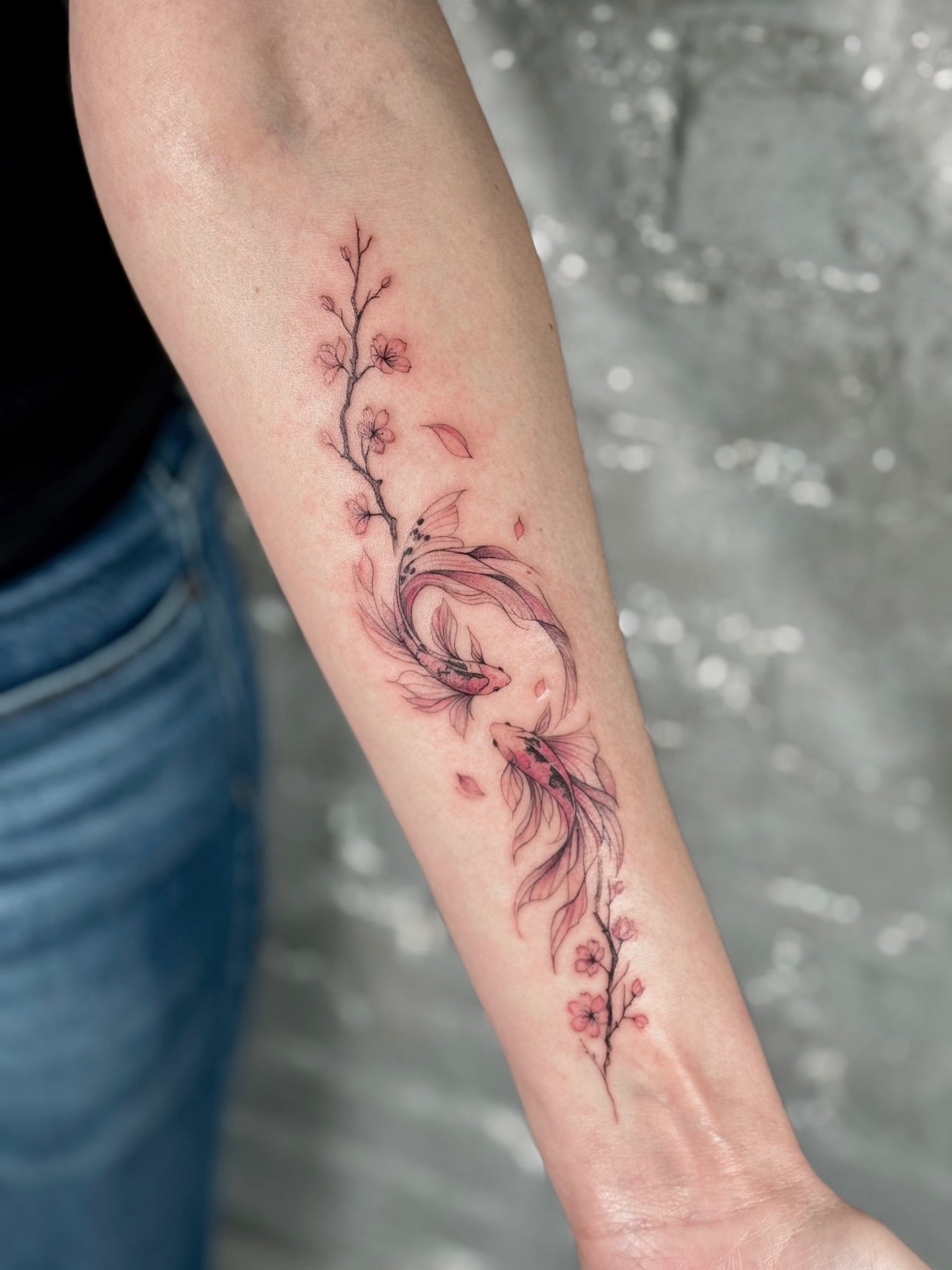
The lotus flower is the most popular companion. Lotuses grow from muddy water yet open into something clean and bright, which mirrors the koi’s transformation almost exactly. Together, they tell a story of becoming something better despite where you started. Cherry blossoms work differently. They represent the fleeting nature of life, the idea that beauty matters precisely because it doesn’t last. A koi paired with sakura tends to read as a meditation on time, loss, and presence rather than triumph.
Other common pairings include water elements like crashing waves for emphasis on struggle, dragons for full transformation imagery, and bamboo for resilience and steadiness. These work especially well in custom large-scale designs where there’s room to develop the composition.
Fine Line vs. Traditional Japanese Koi Tattoos
A japanese koi fish tattoo done in the traditional Irezumi style is bold, saturated, and dense. Heavy black outlines, full color packs, dramatic water and wind imagery surrounding the fish, often covering an entire back, sleeve, or thigh. This style has weight, both visually and historically, and it ages well when done by an artist who understands the craft.
Modern fine line interpretations are a different language entirely. Single-needle work, soft shading, and quieter color palettes turn the koi into something more intimate. The symbolism stays intact, but the visual register shifts from monumental to personal. Fine line koi designs work especially well as smaller stand-alone pieces on the forearm, ribs, or behind the shoulder, and they pair naturally with delicate illustrative styles for clients who want depth without the density of traditional work.
Choosing the Koi That Fits Your Story
The koi tattoo isn’t really about the fish. It’s about what you’ve climbed and what you’re still climbing. The color you pick, the direction it swims, the elements around it, all of those choices turn a beautiful design into something specific to you. Sit with the meaning before the appointment. Look at reference images, think about the chapter you want the piece to mark, and bring that conversation into the consultation. The artists who do this well listen for the story first and sketch second.